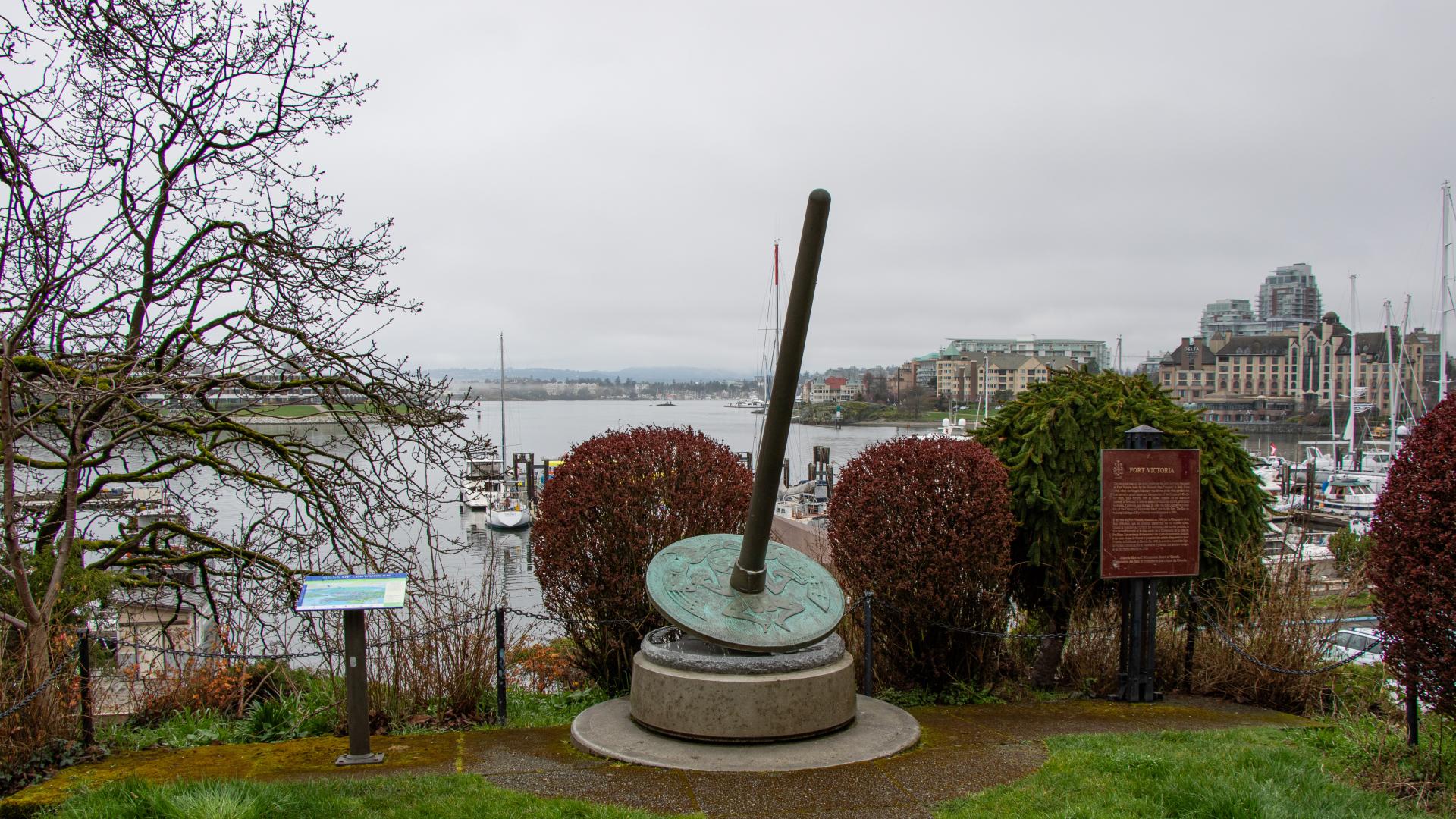
Signs of Lekwungen - Site of the South West Bastion of the Hudson's Bay Company Fort Description This sculpture is one of seven in the Signs of Lekwungen series.
The Signs of Lekwungen consists of seven unique larger-than-life spindle whorl sculptures. Each is a site marker, creating an interpretive walkway along the Inner Harbour and surrounding areas that honours the art, history and culture of the Coast Salish people who have resided in the Victoria area for hundreds of years.
All seven sculptures were carved from a piece of cedar, then cast in bronze and assembled. Spindle whorls were traditionally used by Coast Salish women to spin wool, and were considered the foundation of a Coast Salish family.
Significance of the Hudson's Bay Company Fort Site: An imposing wooden fort, Fort Camosun (later known as Fort Victoria), was built by the Lekwungen men and women in exchange for trade goods. This marked a drastic change in traditional ways and traditional, sustainable land use. A large forested area was destroyed to raise the Fort.
View the Signs of Lekwungen brochure to learn more
About the artist Clarence "Butch" Dick (Yux'wey'lupton)
Master carver and Songhees First Nation elder Clarence "Butch" Dick (Yux’wey’lupton), is an inspiring local visionary trained in fine art who continues to play a pivotal role in youth empowerment and whose tireless commitment to creatively championing the Songhees carving style has touched every generation.
Details Medium
Concrete, granite, bronze, aluminum, and steel
Dimensions
250 × 200 × 100 cm (8 ft 2 in × 6 ft 7 in × 3 ft 3 in)
Site
Foot of Broughton Street at Wharf Street; Fort Victoria National Historic Site
Artwork category
Civic Public Art