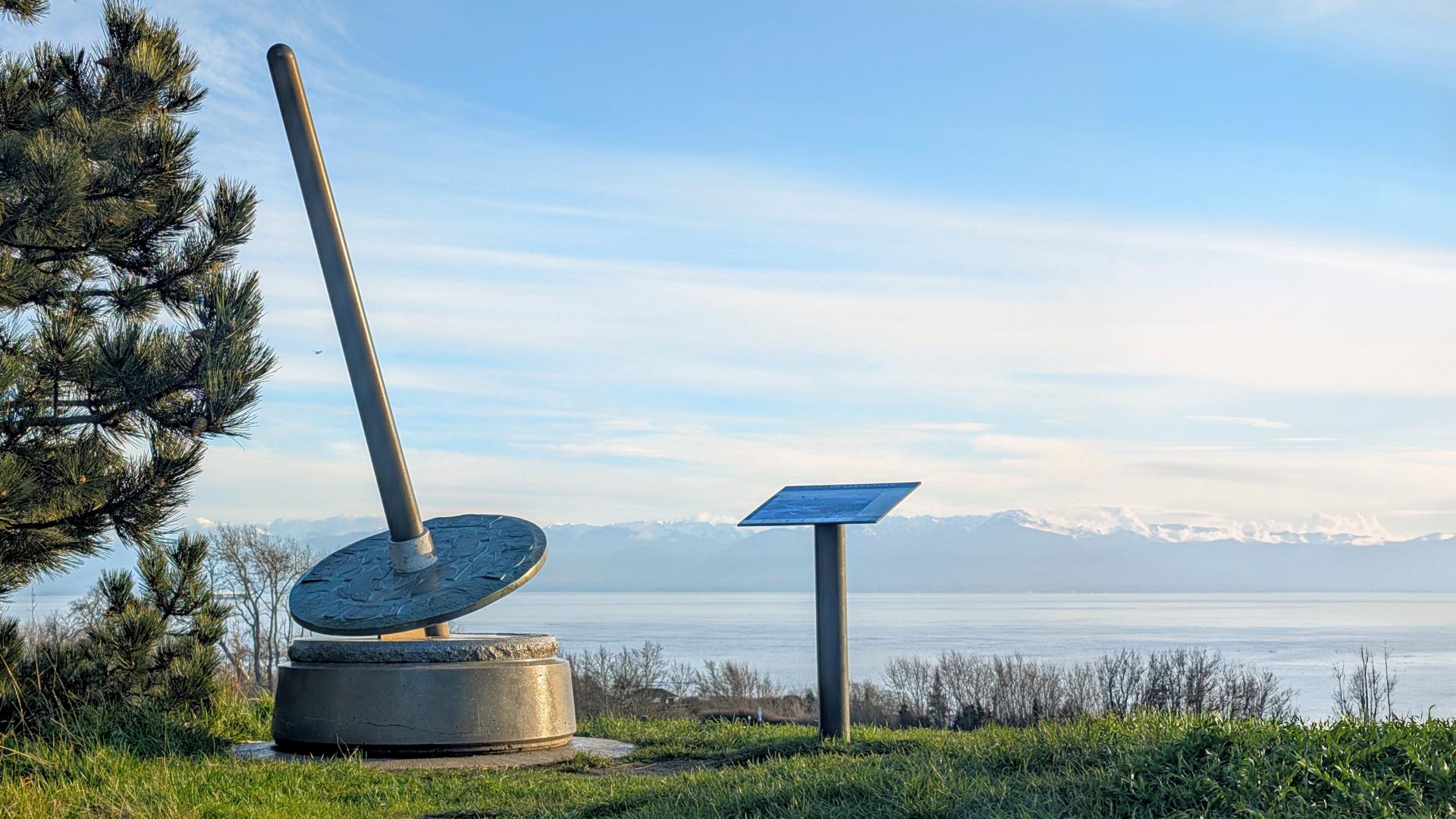
Signs of Lekwungen - Beacon Hill "Lookout" Site Description This sculpture is one of seven in the Signs of Lekwungen series.
The Signs of Lekwungen consists of seven unique larger-than-life spindle whorl sculptures. Each is a site marker, creating an interpretive walkway along the Inner Harbour and surrounding areas that honours the art, history and culture of the Coast Salish people who have resided in the Victoria area for hundreds of years.
All seven sculptures were carved from a piece of cedar, then cast in bronze and assembled. Spindle whorls were traditionally used by Coast Salish women to spin wool, and were considered the foundation of a Coast Salish family.
Significance of the Beacon Hill "Lookout" Site: The lookout area at Beacon Hill Park is called MEE-qan, which means "warmed by the sun." This seaward slope was a popular place for rest and play. A game similar to field hockey, called Coqwialls, was played here. At the bottom of the hill was a small palisaded village that was occupied intermittently until approximately 300 years ago. The settlement was for defence during times of war and it was also important for reef net fishing. The starchy bulbs of the wildflower, Camas, were an important food source gathered in this area.
View the Signs of Lekwungen brochure to learn more
About the artist Clarence "Butch" Dick (Yux'wey'lupton)
Master carver and Songhees First Nation elder Clarence "Butch" Dick (Yux’wey’lupton), is an inspiring local visionary trained in fine art who continues to play a pivotal role in youth empowerment and whose tireless commitment to creatively championing the Songhees carving style has touched every generation.
Details Medium
Concrete, granite, bronze, aluminum, and steel
Dimensions
250 × 200 × 100 cm (8 ft 2 in × 6 ft 7 in × 3 ft 3 in)
Site
Near the summit of Beacon Hill Park next to the lookout point parking lot
Artwork category
Civic Public Art