Family Pole

Image
FamilyPole03-5472x3078blurred
Description

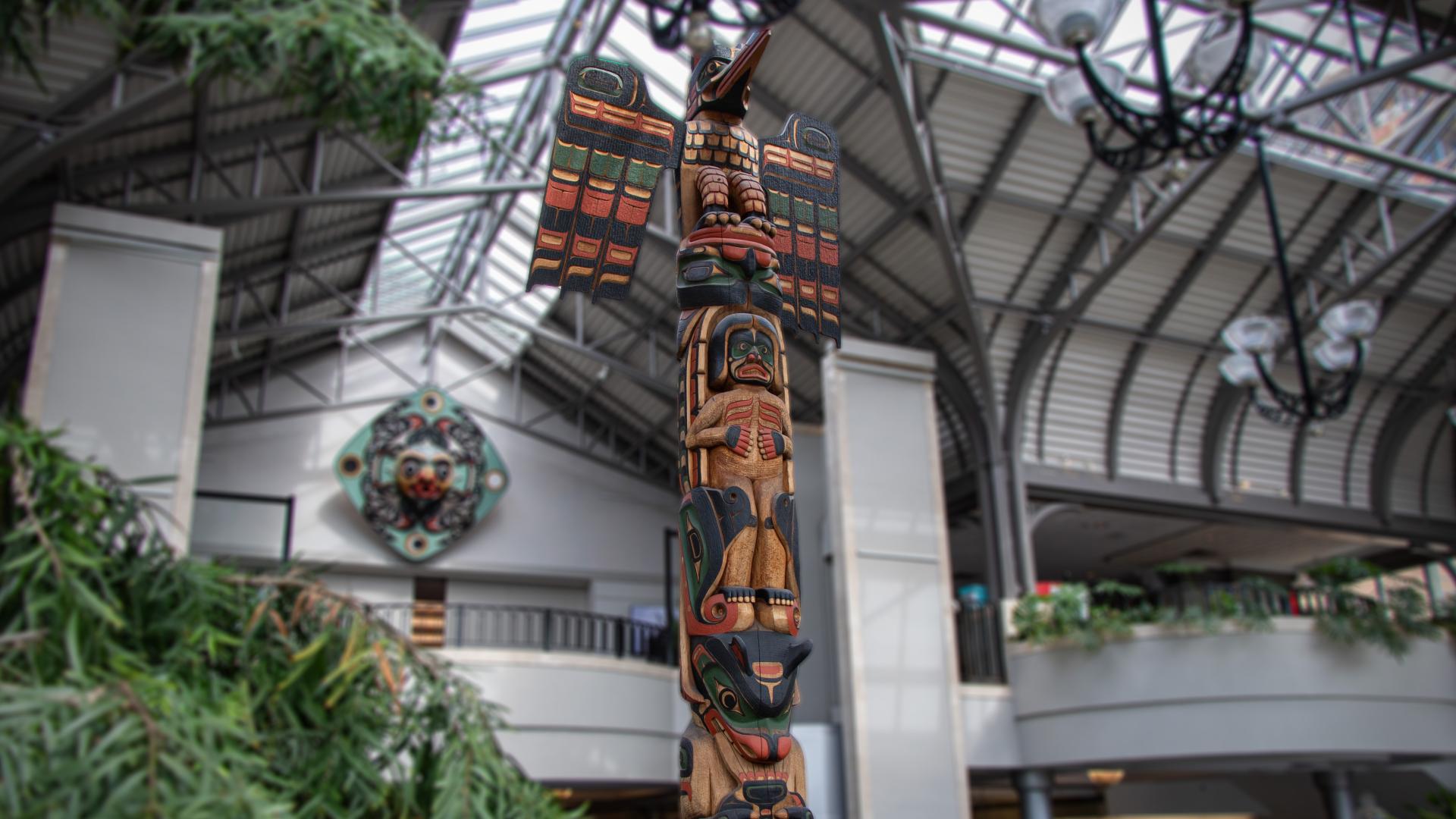
This 25-foot red cedar totem pole incorporates crests from the Hunt family. At the top is Qwanwina, the Raven. Below that is Sisiutl, the double-headed serpent, with a human figure between its two heads. At the base is Nanis, the great grizzly bear of the sea, holding a halibut.

Family Pole was commissioned for display in the Victoria Conference Centre. It was nicknamed "The Pole With Nowhere to Go" because it was completed before the centre had begun construction. Ultimately, an agreement was made to display the pole on the grounds of Government House until its permanent home was ready. It was moved to the conference centre in time for the grand opening.

About the artist
Tony Hunt Sr.

Tony Hunt Sr. (1942-2017) was a world-renowned artist and ambassador of Indigenous knowledge. He is most famous for his KwaGulth style paintings cedar wood carvings and totem poles. Born in the Kwakwaka’wakw community of Alert Bay, Tony was a hereditary chief of the Kwakwaka’wakw through his maternal line. His artwork reflected the stories, kinship and connection of his people with the land. In 2010, he was awarded the Order of British Columbia.

Hunt came from a family of renowned artists. He trained with his maternal grandfather, Chief Mungo Martin (1979-1962), who was the principal carver at the Royal B.C. Museum and an important figure in the Northwest Coast style of art. Tony's father, Henry Hunt, was Martin’s assistant, and Tony his protégé. After his grandfather's death, Tony became his father's assistant. He was taught in the traditional ways that upheld his people’s culture in language, dance, iconography and the practice of the potlatch. His two brothers, Richard and Stanley Hunt , are also professional carvers, as was his son, Tony Hunt Jr. (1961-2017).

Together with his family, Hunt designed and created hundreds of totem poles across Canada, the United States, and around the world. Locally, his work can also be found at Thunderbird Park and the big house at the Royal B.C. Museum, and at the Art Gallery of Greater Victoria. 
Details
Artwork type
First Nations
Medium
Carved and painted cedar
Dimensions
762 cm (25 ft)
Site
Inside the glass atrium of the Victoria Conference Centre
Artwork category
Civic Public Art
Community
Victoria
Date unveiled
1981
Location
Was this page helpful?

Feedback details

You will NOT receive a reply because this form is anonymous. To get an answer to a question, email us at webdesk@crd.bc.ca

Abstract teal and navy blue dragonfly illustrations.

Territorial Acknowledgement

The CRD conducts its business within the Territories of many First Nations, all of whom have a long-standing relationship with the land and waters from time immemorial that continues to this day. Statement of Reconciliation